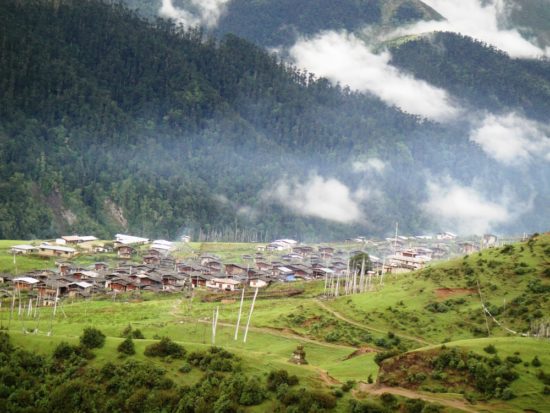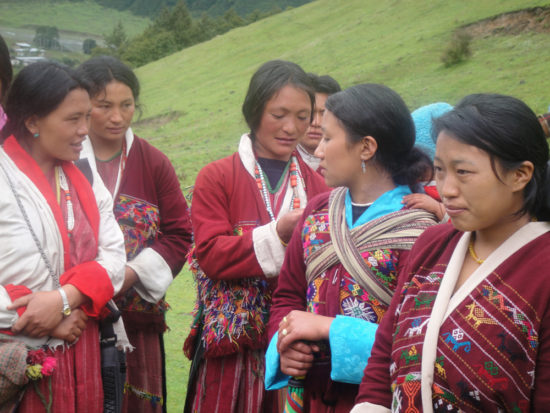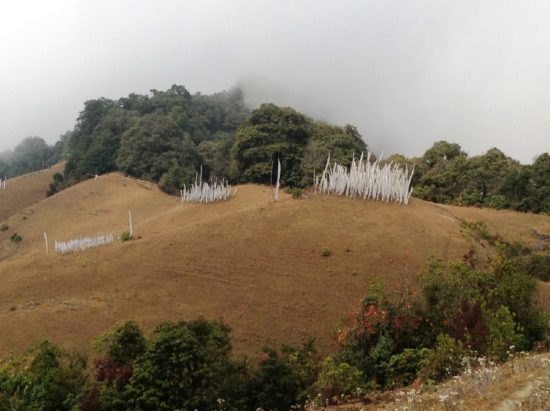

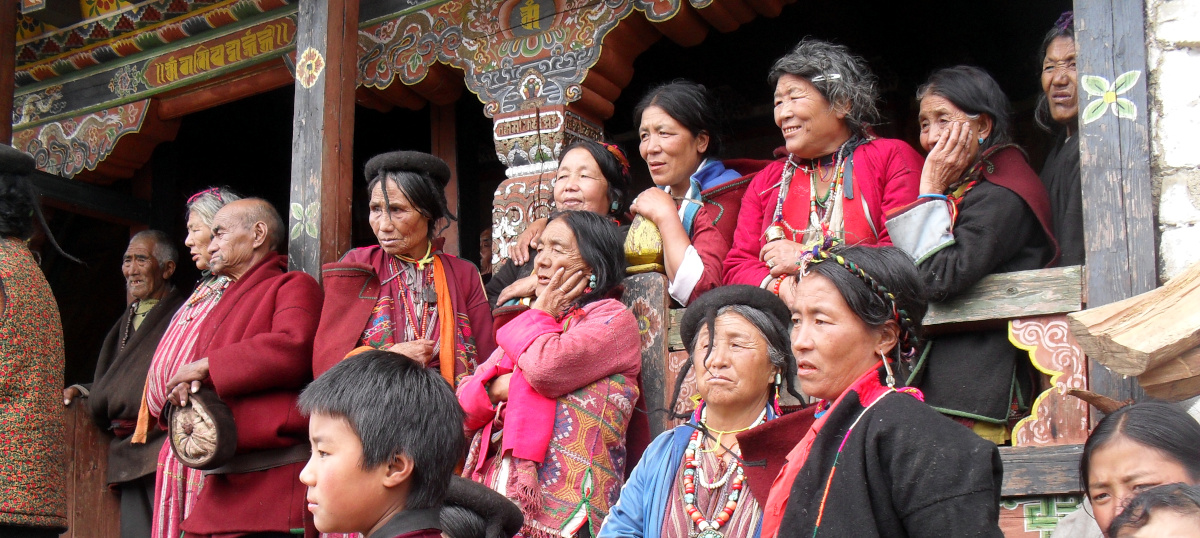
The Merak and Sakteng trek in Eastern Bhutan is a superb 4-day cultural trek, which was newly discovered just a few years ago, as the old trek was ruined due to the motor roads to Merak and Sakteng. The Brokpas, semi-nomadic inhabitants of the region, migrate through the seasons with their yaks, moving between the highlands in summer and the lowlands in winter.
The people of Merak and Sakteng still engage in the barter system, trading cheese, butter, and dried meat for grains and other goods that are not readily available to them. During the colder months, they also travel down south to the villages to barter their goods. So during such times, tourism is not really a viable option as the active population is out with their cattle. However, a few residents do not own animals, and they stay in the villages.
Day 01: Arrive in Paro
The flight to Paro crosses the Himalayas, affording spectacular views of the awesome peaks, including the sacred Jumolhari and Jichu Drake in Bhutan. If you arrive via Kathmandu, which offers the most breathtaking views of the range, you can also see Mount Everest and Mount Kanchenjunga. On arrival, you will be greeted by our representative and transferred to your hotel. In the afternoon, you can visit the Paro Dzong. It was built in 1646 and now houses government offices and religious institutions, as do all the dzongs (forts) currently. You’ll cross a traditional wooden bridge on the way to the dzong. Afterward, you will visit Kyichu Lhakhang, the oldest temple in the country. From there, you will be taken to the Drugyel Dzong (Bhutan Victory Fort), which was built in 1646 to commemorate Bhutan’s victory over Tibetan invaders during the 1600s. On a clear day, you can see Mount Jumolhari, Bhutan’s second-highest mountain at 7,329 meters, from the village below the dzong. In the evening, you can stroll through the Paro market and town. Overnight in Paro.
Day 02: Paro Tiger’s Nest – Thimphu
After breakfast, drive for 20 minutes and start your hike to Taktsang (Tiger’s Nest) Monastery, which is Bhutan’s most famous monastery. Guru Rinpoche is said to have flown on the back of a tigress from Singye Dzong in Lhuntse to meditate in a cave where Taktsang Monastery now stands. It is perched on the edge of a cliff, about 900 meters above Paro Valley. The hike to reach the viewpoint to the monastery makes for a nice half-day excursion. In the afternoon, you will drive to Thimphu. In the evening, you can explore Thimphu, the capital of Bhutan, and absorb the lifestyle of the people. You can also visit some interesting handicraft shops. Overnight in Thimphu.
Day 03: Thimphu Sightseeing
Visit the School of Arts and Crafts, which was established to preserve and promote our age-old practice. The students here are taught 13 different traditional arts and crafts. Visit the folk Heritage museum, to see the house of living traditions in some of the rural areas, or the living house in olden days. Drive to Buddha Point to see one of the largest statues of the Buddha in the world. And visit the mini zoo to see the Takins, which are our national animals. After lunch, you can visit the Handicraft Emporium for your souvenir shopping. Visit the Memorial stupa, which was built in memory of our beloved 3rd King in 1974. Overnight halt at the same hotel in Thimphu.
Day 04: Thimphu – Punakha
After breakfast, drive to Punakha for 2 ½ hours with a short stop at Dochula pass. If the weather is clear, you could have a superb view of the Bhutan’s Himalayas. Upon your arrival in Punakha, you will be taken to your hotel to check in. Have lunch in Punakha town and visit the beautiful Punakha Dzong, built in 1637 by Shabdrung Ngawang Namgyal. Based on the prophecy of Guru Padmasambhava, the dzong is situated between two famous rivers, Pho Chu (Male River) and Mo Chu (Female River). Later in the evening, you can hike to Khamsum Yuelley Namgyel Chorten. The hike is wonderful, offering its fascinating view of the Mochu River and valley. And then return to your hotel, Damchen Resort in Punakha.
Day 05: Punakha – Trongsa via Gangtey (145 km, 5 ½ hrs drive)
You will begin the day by driving to Gantey. You’ll pass through dense forests of oak trees and rhododendrons and arrive at Gantey village, where you’ll visit Gantey Gompa, the only Nyingmapa monastery in western Bhutan. From Gantey, you can see the picturesque Black Mountain range as well as Phobjika Valley, the winter habitat of the black-necked cranes. From there you’ll head to Trongsa, the ancestral home of the royal family. The route is along a spectacular winding road, crossing 3,300-meter-high Pele La, and at certain times of year, it’s possible to see yaks. You can browse through the Trongsa shops and town in the afternoon. Overnight in Trongsa.
Day 06: Trongsa – Bumthang (69 km, 2 ½ hrs drive)
In the morning, you’ll visit Trongsa Dzong, the masterpiece of Bhutanese architecture, and you’ll also see Ta Dzong, the watchtower built to defend this dzong. After lunch, you’ll proceed to Bumthang, the religious heartland of the nation, with lush valleys and hilly forests. Along the way, you will stop at a yethra (textile weaving) factory, where the yethras are designed with patterns unique to Bumthang, and you can even watch some of the weavers at their looms. The afternoon will be spent sightseeing in the area, including Jakar Dzong, the administrative center of the valley; the Udee woodcarving factory in Jakar; Jambey Lhakhang, one of the oldest monasteries in Bhutan, dating from the introduction of Buddhism in Bhutan; and Kurjey Lhakhang, one of the most sacred places, because Guru Rinpoche left his body imprint on the cave when he was meditating. You can spend the evening strolling through Bumthang town. Overnight in Bumthang.
Day 07: Bumthang Sightseeing
The valley is one of the most beautiful valleys in the kingdom. It is also the religious heartland where many saints and masters meditated, leaving their imprints as sacred places of worship and pilgrimage. Tales of Padmasambhava dominate these holy shrines. In the morning, visit Jampa Lhakhang, which was built by Tibetan King Songtshen Gempo in the 7th century to pin down the left Knee of the ogress. And then visit Kurji monastery, where the body imprints of Guru Rimpoche from the 8th century remain preserved upon a rock. Then a short hike to Tamzhing Monastery. If the weather is clear, you will enjoy the view of the green valley, dotted with hundreds of temples, thousands of flags, and the beautiful Chamkhar River flowing through the valley. The valley is also called the mini Switzerland of Bhutan. After Lunch, drive to visit Tang Member Tsho (Burning Lake), Saint Pemalingpa had discovered several hidden treasures from the Lake. Night halt at the same hotel in Bumthang.
Day 08: Bumthang – Mongar (192 km, 6 ½ hrs drive)
You will drive towards eastern Bhutan. The steepness of the region lends itself to some spectacular views, with rushing waterfalls and sheer drops. You will pass through the beautiful Ura valley, which lies at an altitude of 10,000 feet. The journey is one of the most beautiful in all the Himalayas. The descent from Thrumshing La to Lingmithang is astonishing for several reasons. The road drops from 3,800 meters to 650 meters in only a few hours, passing from pine forest through semi-tropical forest to orange groves. Carved out of the side of the mountain, in parts, the road’s edge borders a sheer cliff that drops thousands of feet. Arriving at Mongar marks the beginning of your eastern Bhutan experience.
Eastern Bhutan is famous for its fine weaving. Weavers using backstrap looms produce cotton and silk cloth in incredible colors and patterns. Often, natural colors are made from bark, leaves, and flowers. The predominant ethnic group in Eastern Bhutan is Sharchops, who are generally followers of the Nyingma tradition of Buddhism and tend to be shorter and stockier than people in other parts of the country. Another characteristic of Eastern Bhutan is that the cities and towns are generally built on mountain slopes, a notable exception being Samdrup Jongkhar, which is located in a valley on the Indian border. Sharchopkha is the predominant language of the region, though there are local variations. Overnight halt in Mongar.
Day 09: Mongar – Trashigang (92 km, 3 hrs drive)
After Breakfast, drive to Trashigang, today the rides take us over the Kori la pass at 3000 meters. After the Pass, the road is very beautiful as it has lots of soft turns called Yadi loops through beautiful pine trees. The pretty, lively town of Trashigang is a good jumping-off point to visit the kingdom’s wild east. Few travellers make it here, but as long as you’re happy to leave behind the relative comforts of Thimphu and Paro, exploring this neck of the woods can have its rewards. This is the most densely populated part of Bhutan, but also the most definitely the hinterland. Locals are fond of a tipple, and bodies sleeping off their excesses at the side of the road aren’t an unusual sight. Trashigang Dzong sits on a jagged piece of land jutting out from the town and is the first landmark that can be seen from the road winding up to Trashigang. The Dzong was built in 1659 and commands a spectacular view over the valley for which it is the administrative center. The Dzong is significant for the fact that it has only one courtyard. Overnight in Trashigang.
Day 10: Trashigang – Merak (2. 5 hrs drive)
Day 11: Merak 3480m to Bushinagar
Day 12: Bushinagar to Tsholung Goenpa 4295m
Day 13: Tsholung Goenpa to Rongjung 4090m
Day 14: Rongjung to Sakten 2950m
Note: We will provide the details of the 4-Day trek upon confirming the trip with us.
Day 15: Sakten – Trashigang
The drive to Trashigang takes about 3 hours. If you want, you can visit the Trashigang dzong in the afternoon and have a rest in the afternoon. Overnight stay at the hotel in Trashigang.
Day 16: Trashigang Samdrup Jongkhar (180 Km, 7 hrs drive)
Today we have to start very early; today we will pass through Sherabtse University in Bhutan. Then to the Khaling weaving center, then finally to Samdrup Jongkhar, the exit/entry point of Bhutan. Samdrup Jongkhar is a border town to the Assam border. Check into the hotel.
Day 17: Samdrup Jongkhar – Guwahati, India (110 Km)
Today we will drive to Gawahati, which is 110 Km from the Bhutan Border. The entire drive is in the plains. Time to explore Guwahati and have a farewell dinner before we depart tomorrow. You can catch your flight from Guwahati to your next destination.
Have a pleasant flight back home.
The minimum daily package covers the following services:
- Peak Season Cost: March, April, May, September, October & November
Staring Cost: USD 2,760 per person. - Regular Season Cost: June, July, August, December, January & February
Staring Cost: USD 2,430 per person
Note: Single Room Supplement Cost is, USD 30 per night for 3 Star hotels, USD 65 per night for 4 Star Hotels and around USD 300 for 5 Star Hotels.
The Flight cost for Singapore – Paro – Singapore is, USD 960 per person.
These rates are applicable per tourist per night halt in Bhutan.
1. What sort of past acclimatization/elevation and exercises do you need for this trek?
Ans – One must have done minimum 3-Day trek with at least 3000 meters and above quite recently and must be healthy and fit.
2. What is the minimum number of people required for the trek, and when is the best time or season?
Ans – We normally require minimum 2 people for the trek. yet, we can also conduct the trek for one person also. However, you will have to bear little additional cost. The best time for the trek is in the late spring or end of May, and then in the fall toward the end September.
3. What is the procedure for this trek booking?
Ans – You will have book this trek at least two months ahead with your confirmed flight booking. And then must deposit US $1000 each/30% as an Advance Payment with full airfare only for your flight to/from Paro, Bhutan.
4. Why shall we book this adventure trek with your company?
Ans – We are one of the most local adventures travel company who can render personalized services, with value for money. We make sure to provide very good weather proof trekking equipment, skilled guide/tour leader, good cook and helpers, transports, etc, etc. And we arrange the trek on right time/season, so that it’s mostly a successful trek.
5. Do you apply our Bhutan Visa and what are the documents required for the Visa?
Ans – Yes, we will issue your Bhutan Visa upon receiving the full payment from you. And we only need your clear passport copy for applying the Visa.
6. Do we need to bring our sleeping bag, if so what type or how warm it must be?
Ans – Yes, you will have to bring your own sleeping bag. And it must be minimum minus 20 Degree Celsius dawn feather sleeping bag.
7. What are available flights connecting Bhutan with other cities, and what is the most convenient flight to/from Bhutan. And do you book the flights too?
Ans – We have flights to and from Bangkok, Kathmandu, Delhi, Kolkata, Dhaka, Singapore, Bagdogra and Guwahati. Yet, the most convenient flights to/fro Paro, Bhutan is via Bangkok as we have several flights in a day. Yes, we will book your flight as well, unless you want to do it at your end.
Gallery